
Significant Increase in Eating Disorders Among Young People
New research from the Department of Clinical Medicine and the Capital Region of Denmark shows a clear rise in eating disorders in Denmark between 2000 and 2022. The increase is particularly pronounced among girls in puberty.

A new study from CEDaR at the Psychiatric Centre Ballerup, published in European Eating Disorders Review [link: European Eating Disorders Review], reveals a concerning trend: The number of eating disorders in Denmark has risen sharply from 2000 to 2022. The analysis, based on data from the National Patient Registry, covers anorexia, bulimia, and other eating disorders.
Researchers point out that the prevalence among young people has more than doubled during this period, especially anorexia, which shows significant growth. The findings highlight the need for increased awareness and preventive measures.
Bulimia Declines – But New Diagnoses Are Rising
The study shows that bulimia diagnoses have decreased since 2017. However, researchers believe this trend partly reflects increased focus on binge eating disorder (BED), which is now being diagnosed more frequently.
Eating disorders are most prevalent among girls in puberty. For girls aged 10–14, the rate has risen from 9.7 to 25.5 per 10,000 person-years since 2000, and among 15–19-year-olds, incidence peaked in 2021 at over 34 per 10,000 person-years.
Eating disorders do not disappear on their own, but they can be treated. This is a public health issue, and it is crucial that we have sufficient services and resources to ensure proper diagnosis and treatment.
Boys under 20 also show an increase, especially those aged 10–14, where prevalence has nearly tripled from 1.06 to 2.92 per 10,000 person-years. Researchers note that numbers for boys may be underreported.
Pandemic Worsened the Trend
The study reveals a sharp rise during COVID-19, particularly among girls under 20. For 10–14-year-olds, anorexia increased by 35.5% from 2019 to 2021, while other eating disorders rose by 57.1%. Among boys, the trend was more stable during this period.
“We know that stressful life events—such as a national lockdown—can trigger eating disorders in vulnerable young people. This may combine with increased health focus and growing social media use. A similar rise was seen in other countries, and researchers are now exploring various hypotheses. In this way, the pandemic can also help us better understand the underlying causes of eating disorders,” says Nadia Micali.
Eating Disorders and Comorbidities
Eating disorders are closely linked to mental illnesses such as OCD and medication misuse, as well as serious physical complications like cardiovascular disease and nutritional deficiencies. The increase underscores the need for early detection, greater healthcare capacity, and improved gender-specific diagnostics.
“We need more research to fully understand why eating disorders develop, as this is still unclear. However, we do know that early detection and rapid, evidence-based treatment are crucial for prognosis,” adds Nadia Micali, who, together with postdoc Helena Davies, has been leading the project.
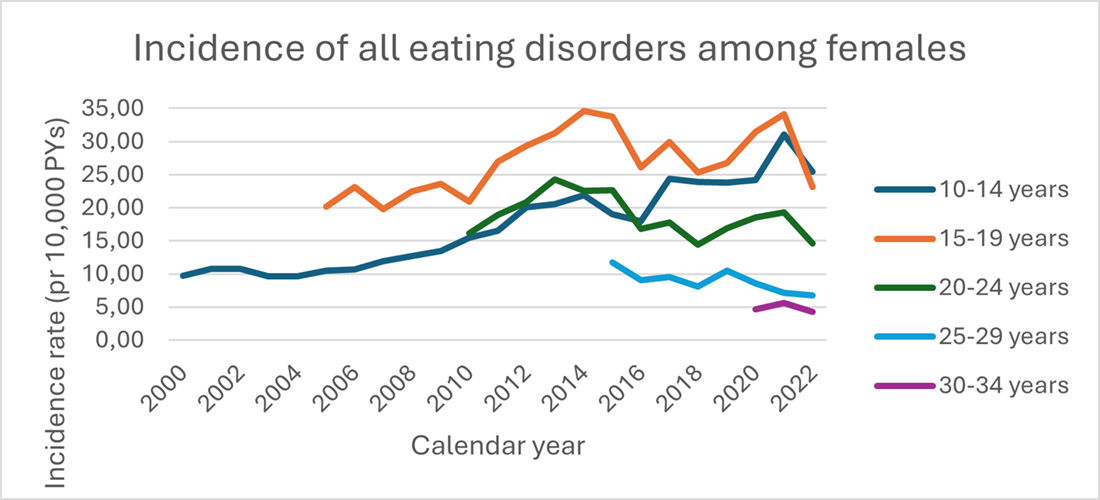
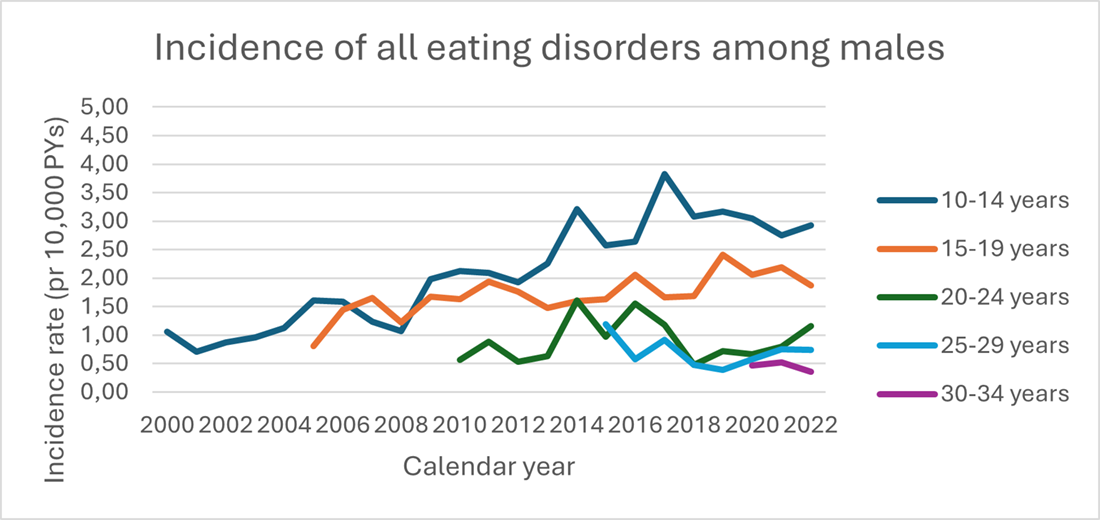
Female (top) and male (bottom) incidence rate per 10,000 person-years (PY) of all eating disorders (anorexia nervosa, bulimia nervosa, and other eating disorders) in the years 2000 to 2022, stratified by age groups (10-14 years; 15-19 years; 20-24 years; 25-29 years; 30-34 years). Incidence is calculated via the number of new events in the given calendar year divided by the number of PY per 10,000 amongst the population at risk, individuals aged ≥10 years on 1 January in the given year who had not previously been diagnosed with an eating disorder.
Contact
Nadia Micali
Clinical Professor,
Department of Clinical Medicine,
University of Copenhagen